
Client Memo: One Question Answered, Three to Go
Sep 21, 2026The Federal Reserve raised rates for the first time in three years. Stocks fell 1%, then had their best day in six weeks. The market was not cheering for higher rates. It was cheering that it finally had an answer.
Markets can live with bad news. What they struggle with is an open question. Four of them have hung over stocks and bonds all year: What will the Fed do about inflation? Who controls Congress after November? Where does oil go if the Iran conflict widens, or resolves? And will the hundreds of billions being spent on AI ever pay for itself?
Each of these is a known unknown. You know the question. You do not know the answer. Investors demand a discount for holding assets while a question like that is open, and that discount lifts when the question closes, whichever way it closes.
On September 16, one of those known unknowns became a known known. This memo covers what happened, why the reaction was healthier than the headlines suggested, and what history says about the next question on the list.
What the Fed did
The Federal Reserve raised its benchmark rate a quarter point to a range of 3.75% to 4.00%. It was the first increase since 2023. The vote was 12 to 0. Wall Street had expected two or three dissents. The statement dropped earlier language that blamed inflation on supply shocks and added a sentence that reads like a promise: “The Committee will deliver price stability.”
Chair Kevin Warsh was blunt in his press conference: “The plain fact is that inflation is too high and has been for too long.” When asked about his committee’s own forecast that inflation would not return to 2% until 2029, he said the projections were not his and that he wanted price stability “on a timelier basis.” He declined to promise anything beyond that, saying, “I’m not in the forward guidance business.”
He also pointed to the strength of the economy and the potential for growth to accelerate. The Fed has now shifted from a balanced approach toward labor and inflation to a single focus on battling inflation.
The problem is that this is a supply-driven shock, not a demand-driven one. If you recall, I have discussed before that oil is in everything we use, make, or eat. The Iran war has pushed the price of oil up sharply, and until that conflict is resolved, oil will stay elevated. That is causing significant inflationary pressure.
Oil rises on geopolitical events (Iran) → inflation rises → interest rates rise → stocks fall
We could see inflation expectations fall tomorrow if the Iran situation were resolved. Or we could see them keep moving higher if the conflict drags on for many more months. In the end, the Fed voted to raise rates to control what it can control: overall economic demand. By raising rates, the Fed slows economic output, which reduces growth and, with it, inflation expectations.
How the market voted
The stock market’s first answer was no. The S&P 500 fell about 1% to a six-week low on decision day, and all eleven sectors closed lower. If you stopped reading there, you would think the hike was a mistake.
The bond market told a different story the same afternoon, and it is the one worth listening to. Short-term yields rose, which is what should happen when the Fed raises short-term rates. But the 10-year Treasury yield, which had climbed from 4.72% in early August to 5.01% going into the meeting, held steady and then began to slip. Market-based inflation expectations fell, with the 10-year breakeven rate dropping to about 2.35%. The dollar strengthened.
In plain English: when short rates go up while long rates and inflation expectations go down, bond investors are saying they believe the central bank will finish the job. Dustin Reid of Mackenzie Investments put it simply: “The unanimous vote really speaks to me. They are very serious.” Matthew Miskin of Manulife John Hancock said the move “makes them look independent” and “adds trust to the market.”
The market was also well positioned for the hike. By going nowhere for the last four months while earnings kept growing, stocks got cheaper on a price-to-earnings basis and had already adjusted to a rising-rate environment.
Next question: November 3
Midterm years are the weakest of the four-year presidential cycle. Stocks tend to drift or fall through the first nine months, bottom in late summer or October, and then rally hard once the result is known. 2026 has followed the script so far: a 9% drop in March, then a choppy climb to a gain of roughly 12% for the year as of early September.
The average full-year return in a midterm year is +3.8%. To put that in perspective, all other years average +10.9%. The average return in the 12 months before a midterm election is just +2.9%, according to U.S. Bank’s analysis of every midterm since 1900.
Midterm years also have the largest average intra-year decline, at 18%. But here is the kicker. The average return in just the six months after the election (this year, November 3) is a strong +13.3%. And the 12 months after a midterm have averaged between 12% and 16% depending on the study and have been positive after all 19 midterms since 1950.
The table below shows the last ten midterm years one at a time: how far stocks fell, when the low came, and what happened over the twelve months after that low.
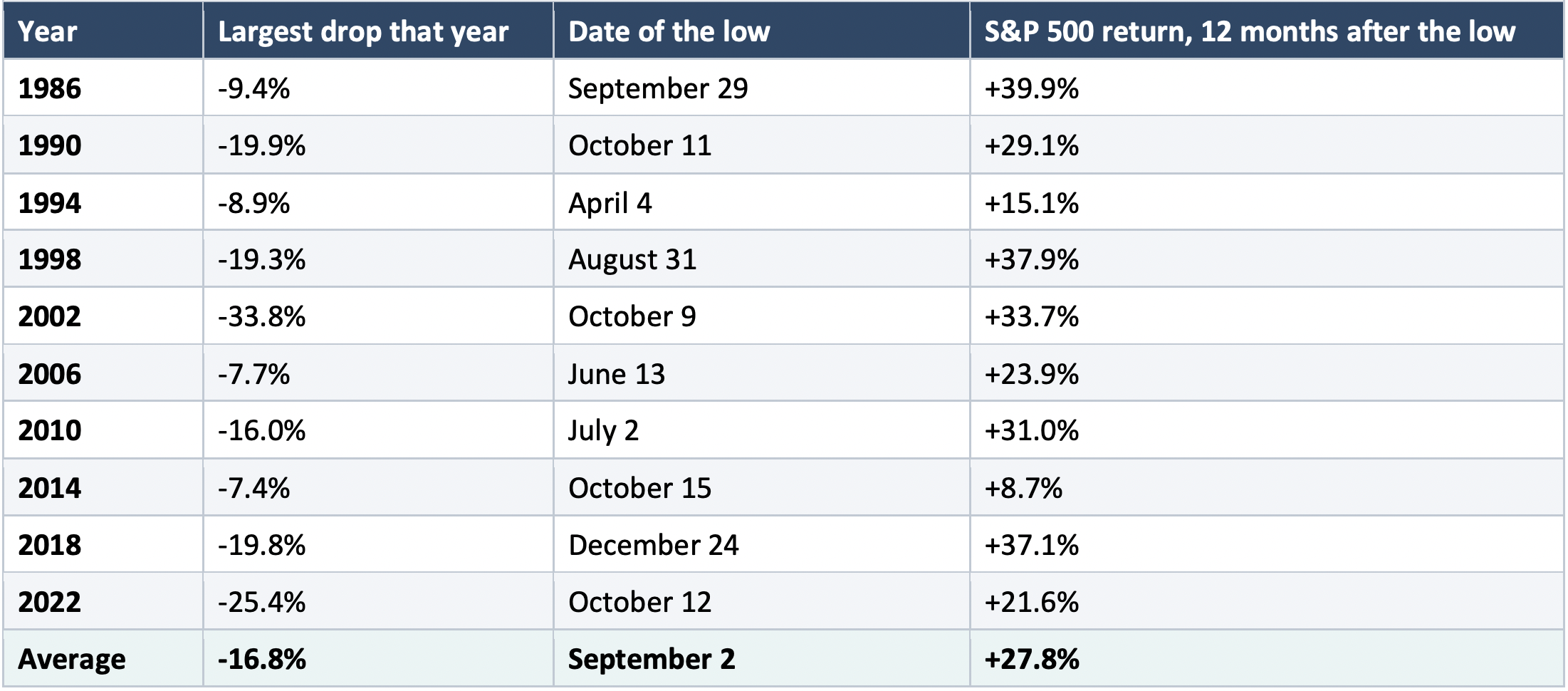
Sources: Hartford Funds with Morningstar data (S&P 500 price returns, 1986 to 2022); CFRA and S&P Global (1945 to 2025); U.S. Bank Asset Management (midterms since 1900); Carson Group (since 1950). Past performance does not guarantee future results.
Three things stand out. In nine of ten years the low came before election day, most often in October. The recovery off that low was positive all ten times, from about 9% to about 40%. And the size of the drop said nothing about the size of the rebound: 2014 had the smallest of both, while 2002 had the deepest drop and one of the strongest recoveries.
Why does the pattern exist? Not because one party is good for stocks. The data does not favor one party over the other at all. BlackRock finds the rally has historically begun about a month before the vote, roughly 22 trading days out, as polls firm up and the range of outcomes narrows. The unknown becomes known, and the premium the market was charging for that unknown goes away.
The open-ended unknown: AI’s return on investment
The Fed question had a meeting date. The election has a date. The AI story has neither, so this unknown will take longer to become known. The answer arrives one earnings report at a time, over many quarters and the years to come.
The question itself is simple. Five companies, Amazon, Microsoft, Alphabet, Meta and Oracle, will spend somewhere between $660 billion and $760 billion on data centers and chips this year, depending on whose estimate you use. That is nearly double what they spent in 2025 and more than the entire annual output of most countries. Will the revenue show up to justify it?
If we look at the data, it already has begun to. GPU rental rates are rising, not falling, which is the opposite of what you would expect if data center capacity had been overbuilt.
Amazon’s cloud unit is running at $142 billion a year and growing 24%. Alphabet’s cloud backlog jumped 55% in a single quarter to more than $240 billion. Microsoft has $80 billion of cloud orders it cannot fill yet because it lacks the power capacity. Warsh himself noted that the leading AI labs are now selling more than $100 billion a year of computing, up more than fivefold from a year ago. Amazon’s chief executive says capacity “is being monetized as quickly as it is installed.” BlackRock’s view, published this month, is that companies that spent heavily over the past three years “have begun to see meaningful returns.”
My take: 2027 could be great
When I look out from here, I think the Fed hikes once more to cement its credibility and show that it is serious about combating inflation. In my opinion, the bar for a third hike is fairly high. Yields have now repriced, and the market is positioned for the full 50 basis points of tightening.
In his press conference, Warsh said the Fed had “removed a dose of accommodation.” To me, that points to an unwind of last year’s three rate cuts, and it suggests the neutral rate is a bit higher than was assumed at the start of 2026.
With the Fed question largely answered (there is still debate over zero, one or two more hikes, but we now know the Fed can and will hike if the data call for it), the market will refocus on earnings.
We will cover this and more in our Client Commentary scheduled for tomorrow afternoon – September 22nd at 3pm MST.
As always, we appreciate the trust you place in us, and we are here to answer any questions you may have.
Sincerely,
Mark J. Asaro, CFA
Educational purposes only; not individualized investment, tax or legal advice. Index figures are unmanaged and cannot be invested in directly. Historical averages are drawn from a small number of election cycles and are not predictive. Market data reflect the dates shown and change daily. Forward-looking statements reflect the author’s opinion and may not come to pass. All investing involves risk, including loss of principal.
Author


