

Client Memo: A Bunch of Short-Term Headwinds Mask the Long-Term Tailwinds
Aug 04, 2026As you may or may not have seen, there has been a bit more volatility in the markets than usual. And by “volatility” we are talking about downside moves since no one complains about volatility on the way up. A correction is typical and healthy in bull markets, and this one is no different. All of them feel like the end of the world. Like the priors, this one won’t be either.
This is a rate-driven correction as well as a structural issue having to do with a foreign market, not the start of an earnings or economic downturn. Yes, the economy has cooled a bit but is more recently showing signs of acceleration.
Where markets, rates, and the economy stand
Interest rates have been moving higher thanks to higher oil prices – brought on by the Iran War as well as the Russia-Ukraine War (recently Ukraine has been targeting Russian oil and gas infrastructure taking about 20% of production offline). Those higher oil prices are filtering through the economy in the form of higher input prices causing higher inflation expectations, causing higher interest rates.
With core inflation still at 3.3%, above the 2% target, the bond market took the hint: the 10-year Treasury yield rose to 4.69%, and the 30-year reached 5.21%, the highest in almost two decades. Higher long term bond yields lower the value investors will pay for future earnings, which is why the most expensive, longest-duration parts of the market, led by technology, fell the hardest. The Nasdaq now sits more than 10% below its high.
This is a slower, higher rates-for-longer backdrop, not a recession signal. An important distinction to make.
Driver One: the data points to a Korea bottom forming
Two fears are amplifying the move: the leveraged blowup in South Korean stocks and worry that Big Tech is overspending on AI. We think both fears are overstated. The Korean unwind is a contained, mechanical deleveraging, and the data suggest it is in its late stages, with a bottoming process likely to play out over the next week or two. The AI spending fear runs directly counter to the demand data. We are staying invested, using the volatility to rebalance, and leaning on quality and bonds that now pay us to wait.
South Korea is an interesting investing culture. The word ‘investing’ isn’t the right one. It would be more of a resemblance to gambling. The cultural mindset of the average South Korean ‘investor’ can be thought of as take as much risk as possible and go for broke.
A recent Reuters article detailed this with just the opening sentence:
Lee Seung-ho watched the nearly 300 million won ($202,515) stock trading fortune he built with a 500% margin loan evaporate in just four weeks in May, but he plans to borrow again and return to the market the moment he has enough capital.
Korean government policy pushed household savings out of real estate and into stocks, and investors piled in with borrowed money, concentrated in two names, Samsung Electronics and SK Hynix, which together accounted for about a third of all margin debt in the market. Not only did retail investors use margin, but they then went and bought leveraged ETFs on single stocks like Samsung and SK Hynix, further amplifying their exposure.
Margin loans peaked at a record 38.6T won in late June. When the two chip giants wobbled together, the leverage cut the other way and forced a cascade of selling. The KOSPI has fallen roughly 40% from its June peak, more than 1.2M margin accounts have been called, and about 500,000 have been liquidated. 62% of those wiped out were under 35.
A margin-driven decline burns itself out as the leverage disappears, and several measures suggest that process is well advanced.
Foreign investors have begun buying the shares that retail sellers are dumping, Samsung just posted record earnings, and regulators have banned new single-stock leverage products, raised margin requirements, and readied a market stabilization fund. Taken together, these point to a bottoming process that likely completes over the next week or two rather than a decline in its early innings. We would not call an exact low, and further sharp days are possible while the final positions clear, but the weight of the evidence has shifted toward stabilization. Throughout, the fundamentals of the underlying companies have not changed; the leverage has.
Driver Two: the AI spending scare does not match the data
The second worry is that the five hyperscalers, Amazon, Alphabet, Meta, Microsoft, and Oracle, are pouring roughly $700B into AI infrastructure this year and will never earn it back. The concern is fair to ask but hard to support once you look at what customers are actually committing to spend. The order books are enormous and still growing:
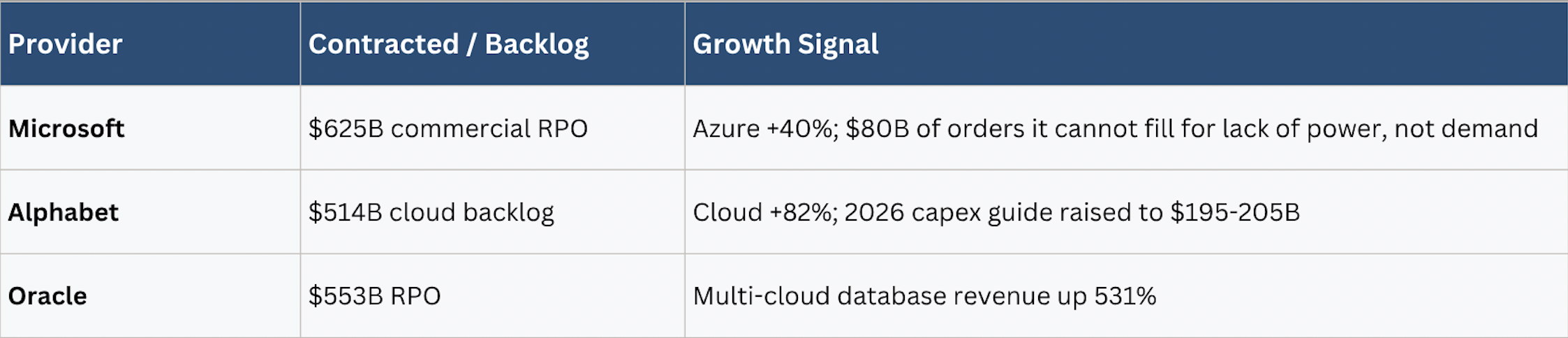
Across the group, contracted future revenue now totals roughly $2T, that’s trillion with a ‘T’. The clearest indicator is Microsoft's disclosure that it has about $80B of orders it cannot fill, and the bottleneck is electricity and data-center power, not weak demand. That is the opposite of an overbuild. Usage is climbing too: newer AI agents consume 10 to 100 times more computing per task than simple chatbots, and Goldman Sachs projects total AI usage could rise more than twentyfold by 2030.
These companies are now spending 45% to 60% of their revenue on capital projects, a level that looks more like a utility than a software firm. If even one of them signals a pause, the stocks would reprice quickly, and the spending is pulling forward a lot of future growth. But a pause is a valuation and timing risk, not evidence that the demand is fake. Backlogs this large, growing this fast, held back by power rather than customers, are not the fingerprints of a bubble about to burst. We think the capex fear is the most overblown part of this correction.
The Long-Term Tailwind being hidden
These drivers are structural, not fundamental, and these things often happen during bull markets. I can cite several of them during the dot-com boom of the 90s, including, most notably, the Long-Term Capital Management blowup.
Corrections triggered by rates and forced selling tend to be sharp and short, and they reward investors who stay disciplined. Practically, that means three things. First, we are rebalancing, trimming what held up and adding to quality that was sold off indiscriminately.
Second, we are glad to own bonds again: with the 10-year near 4.7% and the 30-year above 5%, high-quality fixed income finally pays a competitive yield and cushions equity volatility.
Third, we are keeping cash working rather than sitting on the sidelines waiting for an all-clear that never rings a bell.
As always, we are here to answer any questions or concerns you may have.
Sincerely,
Mark J. Asaro, CFA
Noble Wealth Management, PBC.
Author


